| IN SEARCH OF ATLANTIS AND KING SOLOMONS MINES Brought to you by Mary Sutherland Copyright 2006 HOME PAGE |

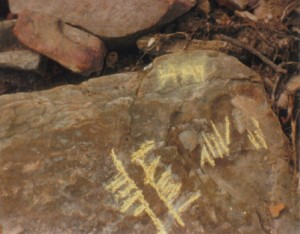
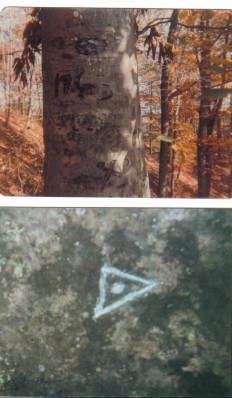
| The triangle with dot in center was found on rock below the intiation cave area. The three lines making the triangle could be indicators representing the energies of the trinity. Father, Son and Holy Ghost. The mark in the center could represent the power manifested. Another form of a anagram |
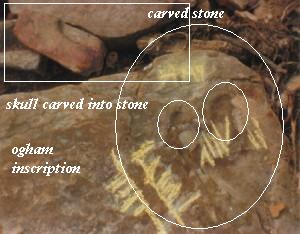
| Ogham inscriptions are found around the temple area. This particular stone seems to have a skull carved into it with possible name of spirit and history behind it. Note also the carved stones above the main stone - Faces carved in stone are important indicators in the search for even more clues. Sometimes the direction the head points leads to either a cache or more clues. Note the Photo to the right is of the man. Under the Bull Carved Stone is where we found the initiation cave for rites of passage. In Burlington, the brass plates of the ancient ones were found buried under a tree. Near the burial site was a carved head with nose pointing east - which was oth the area of the buried plates but where the bodies were buried in a mine , near a quarry. See Voree |

| Anagram (Greek ana='back' or 'again', and graphein = 'to write) is a word or phrase spelled by rearranging the letters of another word or phrase. The construction of anagrams is an amusement of the great antiquities. Jews are often credited with the invention of anagrams. The Hebrew writers, particularly Kabbalists, were fond of it, asserting that "secret mysteries are woven in the numbers of letters" Anagrams are often expressed in the form of an equation, with the equals symbol (=) separating the original subject and the resulting anagram. ‘Earth = heart’ is an example of a simple anagram expressed in that way. In a more advanced, sophisticated form of anagramming, the aim is to ‘discover’ a result that has a linguistic meaning that defines or comments on the original subject in a humorous or ironic way; e.g., Roll in the hay = Thrill a honey (discovered by Tony Crafter). When the subject and the resulting anagram form a complete sentence, a tilde (~) is used instead of an equal sign; e.g., Semolina ~ is no meal. Anagrams An anagram is a rearrangement of a certain section of the clue to form the answer. This is usually indicated by words such as 'strange', 'bizarre', 'muddled', 'wild', 'drunk', or any other term indicating change. One example might be: Chaperone shredded corset (6) gives ESCORT, which means chaperone and is an anagram of corset, indicated by the word shredded. Anagram clues are characterized by an indicator word adjacent to a phrase that has the same number of letters as the answer. The indicator tells the solver that there is an anagram they need to solve in order to work out the answer. Indicators come either before or after the letters to be anagrammed. In an American cryptic, only the words given in the clue may be anagrammed; in some British puzzles, the words to be anagrammed may be clued and then anagrammed. So in this British clue: Chew honeydew fruit (5) chew is the anagram indicator, honeydew" clues melon, which is to be anagrammed, and "fruit" is the definition for the answer, LEMON. Other possible anagram indicators, among the thousands possible: Abstract, Absurd, Alien, Alternative, Awkward, Bad, Barmy, Blend, Break, Camouflaged, Careless, Chaotic, Clumsy, Contrived, Convert, Corrupt, Design, Develop, Doctor, Eccentric, Error, Evil, Fabricate, Fake, Fix, Fudge, Ground, Hammer, Hatch, Hybrid, Jostle, Knead, Loose, Lose, Make, Maybe, Messy, Mutant, New, Novel, Odd, Old, Order, Outrageous, Peculiar, Poor, Questionable, Remodel, Resort, Rough, Set, Sort, Style, Tease, Troubled, Twist, Unconventional, Unsound, Vague, Vary, Whip, Worry. Numerical Anagrams Numerical anagrams use Roman numerals within words. These numeral letters, taken together according to their numerical values, express some epoch, such as the year of an event. An example of this kind is a distich of Godart on the birth of the French king Louis XIV, which occurred in the year 1638, on a day wherein there was an astrological conjunction of the Eagle with the Lion's Heart: "eXorIens DeLphIn aqVILæ CorDIsqVe LeonIs CongressV gaLLos spe LætItIaqVe refeCIt." This roughly translates to, "On the conjunction of the eagle and the heart of the lion, the new Dauphin brings hope and happiness to the French." The highlighted Roman numerals sum to 1638.[1] Astronomy Perhaps the only practical use to which anagrams have been turned is to be found in the transpositions in which some of the astronomers of the 17th century embodied their discoveries with the design apparently of avoiding the risk that, while they were engaged in further verification, the credit of what they had found out might be claimed by others. Thus Galileo announced his discovery that Venus had phases like the Moon in the form "Haec immatura a me iam frustra leguntur—oy" (Latin: This immature (feminine) one has already been read in vain by me—oy (with a subject- verb number agreement error***)), that is, "Cynthiae figuras aemulatur Mater Amorum" (Latin: The Mother of Loves [= Venus] imitates the figures of Cynthia [= the moon]). Similarly, when Robert Hooke discovered Hooke's law in 1660, he first published it in anagram form. One might think of this as a primitive example of a zero-knowledge proof. *** edit = "Haec immatura" = Neuter plural "these immature ones". The verb leguntur indeed agrees with the subject.*** Crosswords Cryptic crossword puzzles frequently use anagrammatic clues, usually indicating that they are anagrams by the inclusion of a word like "confused" or "in disarray". An example would be Businessman burst into tears (9 letters); the solution, Stationer is an anagram of into tears, the letters of which have burst out of their original arrangement to form the name of a type of businessman. How cryptic clues work In essence, a cryptic clue describes its answer accurately but only when the clue is read in a very devious way. What the clue appears to say when read normally (the surface reading) is almost never anything to do with the answer and is there as a distraction. The challenge for the solver is to find a way of reading the clue that leads to the solution. In a typical clue, the answer is described twice: One part of the clue is a definition and a second part (the subsidiary indication) describes the answer in terms of wordplay. (The subsidiary indication can be a second definition in the case of double definition clues.) One of the tasks of the solver is to work out where this boundary occurs and insert a mental pause there when reading the clue cryptically. (Sometimes the two parts are joined with a link word or phrase.) Because a typical cryptic clue describes its answer in detail and often more than once, the solver can usually have a great deal of confidence in the answer once it has been found. This is in contrast to non-cryptic crossword clues which often have several possible answers and force the solver to use the crossing letters to distinguish which was intended. Here is an example (taken from The Guardian crossword of Aug 6 2002, set by "Shed"): 15D: Very sad unfinished story about rising smoke (8) is a clue for TRAGICAL. This breaks down as follows: 15D: indicates location and direction (down) of clue in grid "Very sad" is the definition. "Unfinished story" gives "Tal" ("tale" with one letter missing, ie "unfinished") "rising smoke" gives "ragic" (a "cigar" is a smoke and this is a down clue and so "rising" indicates that "cigar" should be written going up the page i.e. backwards) "about" means that the letters of "tal" should be put either side of "ragic", giving "tragical" "(8)" says that the answer is a single word of eight letters. There are many "code words" or "indicators" which have special meaning within the cryptic crossword context (in the example above, "about", "unfinished" and "rising" all fall into this category) and learning these, or being able to spot them, is a useful and necessary part of becoming a skilled cryptic crossword solver. Types of clue Pure cryptic The original cryptic clue, more commonly known as a double entendre or cryptic definition. Clues of this sort appeared in "straight" crosswords before cryptic crosswords existed. Here the clue appears to say one thing, but with a slight shift of viewpoint it says another. For example: A word of praise? (8) would give the answer ALLELUIA, a word used by Christians to praise God, but not what first springs to mind on reading the clue. Notice the question mark - this is often (though by no means always) used by compilers to indicate this sort of clue is one where you need to interpret the words in a different fashion. The way that a clue reads as an ordinary sentence is called its surface reading and is often used to disguise the need for a different interpretation of the clue's component words. Another one might be: The flower of London? (6) which gives THAMES, a flow-er of London. Here, the surface reading suggests a flower, which disguises the fact that the name of a river is required. This type of clue rarely appears in American cryptics, but is common in British and Canadian cryptics. Double definition A clue may, rather than having a definition part and a wordplay part, have two definition parts. Thus Not seeing window covering (5) would have the answer BLIND, because both "not seeing" and "window covering" can mean blind. Note that since these definitions come from the same root word, an American magazine might not allow this clue. American double definitions tend to require both parts to come from different roots, like in this clue: Eastern European buff (6) This takes advantage of the two very different meanings (and pronunciations) of POLISH, the one with the long "o" sound meaning "someone from Poland" and the one with the short "o" sound meaning "make shiny." These clues tend to be short; in particular, two-word clues are almost always double definition clues. Hidden words This is when the answer appears in the clue, but it is hidden within one or more words. For example: Found ermine, deer hides damaged (10) gives UNDERMINED, which means (or could mean - sometimes definitions are a little shaky) "damaged" and can be found as part of "Found ermine deer". The word "hides" is used to mean "contains," but in the surface sense suggests "pelts". Possible indicators of a hidden clue are "in part", "partially", "in", "within", "hides", "conceals", "some", and "held by". Another example: Introduction to do-gooder canine (3) gives DOG, which is the first part of, or "introduction to", the word "do-gooder", and means "canine". Canaanite Using the anagram CAN - we can trace the CANaanites to North America and link them to the CANary Islands during Ancient Times. . Most people are under the assumption that the name CANARY (canari) originated from the discovery of the yellow birds that populated that area. Not true - According to the Latin definition of Canari , it means 'DOG', (CANine). When Roman ships visited the islands in the Second Century BC , the original inhabitants revered the dog as a 'SACRED BEING' The Romans called these inhabitants of the Islands ' Dog People' . The islanders veneration of the dog resembles the Egyptians belief in ANUBIS, the dog headed spirt guide who led the souls from the material world , through the veil, to the other side into the afterlife. (In Pharaonic Egypt, at Cynopolis, or 'DOG CITY' , literally tens of thousands of mummified dogs were found buried.) These type of dog rituals can also be found in Aztalan, located at Rock Lake Wisconsin. (See Rock Lake ) Reversals A word that gets turned around to make another is a reversal. For example: Returned beer fit for a king (5) The answer is REGAL. "Lager" (i.e., "beer") is "returned" to make regal. Other indicator words include "receding", "in the mirror", "going the wrong way", "to the left" or "left" (for across clues), and "rising" or "overturned" (for down clues). Hidden backwards Sometimes the above two clue types are combined. A word may be hidden backwards, such as in the clue: Cruel to turn part of internet torrid The answer to this clue is ROTTEN. The phrase "to turn" indicates "to reverse," and "part of" suggests a piece of "internet torrid". "Charade" clues Here the answer is formed by joining individually clued words to make a larger word (namely, the answer). For example: Outlaw leader managing money The answer is BANKING formed by BAN for "outlaw" and KING for "leader". The definition is "managing money". With this example, the words go next to each other in the clue as they do in the answer - it isn't specifically indicated. However, where the parts go in relation to others is sometimes indicated with words like "against", "after", "with" or (in a down clue) "above". Containers A container clue puts one set of letters inside another. So: Perfume cloth seen in European nation gives FRAGRANCE, placing "rag" ("cloth") inside "france" ("European nation"). Other container indicators are "around," "clutching," "enters," and the like. |
Using Anagrams in the Coded Secrets of the Ancient Atlanteans
What you 'see' in a symbol does not necessarily have that exact meaning.
Mary Sutherland 2006 Copyright
A cryptic clue describes its answer accurately but only when the clue is read in a
very devious way.
What the clue appears to say when read normally (the surface reading) is almost
never anything to do with the answer and is there as a distraction. The challenge
for the solver is to find a way of reading the clue that leads to the solution.
What you 'see' in a symbol does not necessarily have that exact meaning.
Mary Sutherland 2006 Copyright
A cryptic clue describes its answer accurately but only when the clue is read in a
very devious way.
What the clue appears to say when read normally (the surface reading) is almost
never anything to do with the answer and is there as a distraction. The challenge
for the solver is to find a way of reading the clue that leads to the solution.
Mary Sutherland is the author of the following books
Check Out Books Written by Mary Sutherland She is also the creator of
BURLINGTON NEWS one of the largest and most popular websites on the world
wide web.
- Living in the Light: Believe in the Magic
- Mysteries: Exploring the Mysteries of Burlington and Southeastern Wisconsin
- Revelations: Truths Revealed
- In Search of Ancient Man: Lost in Time
- The Red Haired Giants
- Haunted Burlington Wisconsin
Check Out Books Written by Mary Sutherland She is also the creator of
BURLINGTON NEWS one of the largest and most popular websites on the world
wide web.
| Exploring the Unknown with Mary Sutherland |

| Member Shite Archived Shows Listen to all our Shows by Mary Sutherland |




| Mary Sutherland is an author and researcher focusing her work on consciousness studies, ancient history and unusual phenomena. She is a "hands on" researcher and the creator of one of the largest website on the internet with hundreds of pages providing information on the paranormal, UFOs, ancient races and their cultures, sacred sites and power points of the world, underground tunnels and cave systems, dimensional worlds , metaphysics, etc. The governor of Kentucky commissioned her as a ‘Kentucky Colonel” for her work on the ancient sites of Kentucky. For the last 5 years, she has been exploring, mapping and documenting the ancient underwater structures of Rock Lake – near Aztalan. For the last fourteen years she has been documenting the ancient sites around Burlington, WI. Truth is her passion. She believes it is through truth that we will break ourselves free of our present entanglements in life. When we become free, we will create our own ‘personal story’ of the ‘hero’s journey’ suggested by Joseph Campbell. |
| CONTACT US TODAY Brad and Mary Sutherland 248 Carver Street Winslow, Illinois 61089 815 367 1006 |
“There are rare persons in this world who see things others
don’t; persons who connect the dots of existence and
possess an instinctive talent for linking with kindred souls to
reveal otherwise invisible patterns and excavate hidden
truths. Such a person is Mary Sutherland. She is a natural-
born networker in all she does --- from her Burlington
Vortex Conferences and Sci’Fi Café to her public talks and
published books. Nowhere, however, is her gift for
perception more developed than in her latest title.“ Frank
Joseph .
Joseph was nominated by Japan's Savant Society as
Professor of World Archaeology. He was editor-in-chief of
Ancient American Magazine from 1993 to 2007 and has
traveled the world collecting research materials for his
twenty-seven published books.
don’t; persons who connect the dots of existence and
possess an instinctive talent for linking with kindred souls to
reveal otherwise invisible patterns and excavate hidden
truths. Such a person is Mary Sutherland. She is a natural-
born networker in all she does --- from her Burlington
Vortex Conferences and Sci’Fi Café to her public talks and
published books. Nowhere, however, is her gift for
perception more developed than in her latest title.“ Frank
Joseph .
Joseph was nominated by Japan's Savant Society as
Professor of World Archaeology. He was editor-in-chief of
Ancient American Magazine from 1993 to 2007 and has
traveled the world collecting research materials for his
twenty-seven published books.
"Mary Sutherland is not simply a reporter of all these phenomena;
she lives them! As readers expect, her studies extend beyond her
own experiences. The author and investigator often takes visitors
on tours containing an inter-dimensional vortex and hosts yearly
conferences and meet ups with many well known speakers on
anomalous phenomena."
What differentiates her book. Haunted Burlington Wisconsin , is that
Sutherland includes her explanations of the unknown realms and
phenomena with tips for heightening the reader's own psychic
awareness. Readers who complete this dizzying journey may find
they can no longer look at Burlington in exactly the same way.
Perhaps, then, this book itself may be considered a vortex. and
whether or not it actually transports you to another place, it will
certainly draw you in."
Linda Godfrey , award winning author on strange creatures, people
and places. She has been featured guest on dozens of nation TV
and radio shows, including Monsterquest, Sean Hannity's America,
Lost Tapes, Inside Edition, Sy-fy's Haunted Highway, Monsters and
Mysteries, Coast to Coast...and the list goes on!
she lives them! As readers expect, her studies extend beyond her
own experiences. The author and investigator often takes visitors
on tours containing an inter-dimensional vortex and hosts yearly
conferences and meet ups with many well known speakers on
anomalous phenomena."
What differentiates her book. Haunted Burlington Wisconsin , is that
Sutherland includes her explanations of the unknown realms and
phenomena with tips for heightening the reader's own psychic
awareness. Readers who complete this dizzying journey may find
they can no longer look at Burlington in exactly the same way.
Perhaps, then, this book itself may be considered a vortex. and
whether or not it actually transports you to another place, it will
certainly draw you in."
Linda Godfrey , award winning author on strange creatures, people
and places. She has been featured guest on dozens of nation TV
and radio shows, including Monsterquest, Sean Hannity's America,
Lost Tapes, Inside Edition, Sy-fy's Haunted Highway, Monsters and
Mysteries, Coast to Coast...and the list goes on!

