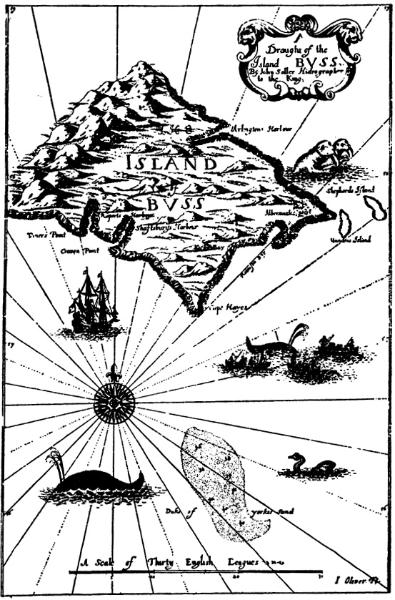
| Is this map a hoax or could it be Atlantis? In September 1578, while sailing near Greenland’s southernmost point at Cape Farewell, captain James Newton of the Emmanuel recorded in his log the first sighting of an island “seeming to be fruiteful, full of woods, and a champion countrie.” The island came to be known as Buss, after the type of boat that discovered it – the Emmanuel being a short, two-masted herring buss. And despite its non-existence, Buss Island appeared on nautical maps of the area well into the 19th century, making it one of the more persistent of the many phantom islands that once dotted maps of the North Atlantic. The existence of Buss Island was first made public in a book written by George Best in the same year of its discovery, called A True Discourse of the Late Voyages of Discouerie for Finding of a Passage to Cathaya by the North-Weast, under the Conduct of Martin Frobisher, Generall. It appeared on the Molyneux globe (1592) and a Plancius map (1594), and was again spotted in 1605 by James Hall, albeit in a different place from where he expected it. No matter: Buss Island continued to make regular map appearances, was deemed as real as Frisland (another fabrication since disproved – and mentioned earlier on this blog) or Greenland (which still exists). It was sighted again in 1668 by Zachariah Gillam, captain of the Nonsuch (sic). The 1671 claim by Thomas Shepherd, captain of the Golden Lion, to have visited, explored and mapped the island extensively, led to an royal charter and an expedition aimed specifically at Buss. Shepherd’s description was tantalisingly precise (this map by John Seller, from 1673, details Shaftesbury Harbour and Arlington Harbour and a small, outlying Shepherd Island, among other illegible data). But of course, the elusive island would only reveal itself to sailors not looking for it, not to those who sought it out. This stubborn refusal to be found, coupled with an increase of transatlantic traffic, caused the presumed size of Buss Island to shrink and later its very existence to be questioned. Eventually, it was presumed the island had ’sunk’, a theory that reconciled the earlier, incontrovertible eyewitness reports with its obvious absence. It took another Arctic expedition to also put the sinking theory to rest. In 1818, the Isabella, captained by John Ross (and still looking, as Frobisher had been, for the Northwest Passage) established that there were no shallows in the area proposed for Buss’s sinking. Ironically, Ross himself mistook a North Atlantic mirage for dry land, naming it “Crocker Hills”; the controversy of their either-or-not- existence would later dent his reputation (which was later redeemed by his discovery of the magnetic north pole, and the heroic, 4-year expedition during which he made it). Only in 1856 would Buss Island disappear from the last nautical charts, the rich potential of its existence finally yielding to the disappointing reality of its un-discovery. The only mysteries remaining are what might have been mistaken for Buss Island: mirages? Parts of Greenland? Lies or delusions to make a dreary North Atlantic trip more interesting? This map taken from this page at Cape May Magazine. |
| Ancient Maps Supporting theories that the Aztec and Toltecs were in North America First - THEN migrated South Click Here |

Ancient Maps
Author of the World's Best Selling Books on Giants and Ancient Man
Purchase Red Haired Giants and Mary Sutherland's Other Books Here or on Amazon
Burlington News Home Page
Ancient Races Home Page
Author of the World's Best Selling Books on Giants and Ancient Man
Purchase Red Haired Giants and Mary Sutherland's Other Books Here or on Amazon
Burlington News Home Page
Ancient Races Home Page

| Help Support Mary Sutherland's Work by sending a Donation. Thank You. |
In Search of Ancient Copper
Culture and Mound Builders
with Brad and Mary
Sutherland
Rock Lake
Aztalan
Franks Hill
Burlington
Michigan
Culture and Mound Builders
with Brad and Mary
Sutherland
Rock Lake
Aztalan
Franks Hill
Burlington
Michigan
| Did A Race of Giants Pre-Exist Modern Man GIANTS OF NORTH AMERICA Back to Giants Home Page |
